
What are Spicules in Skincare: Liquid Microneedling Key Ingredient
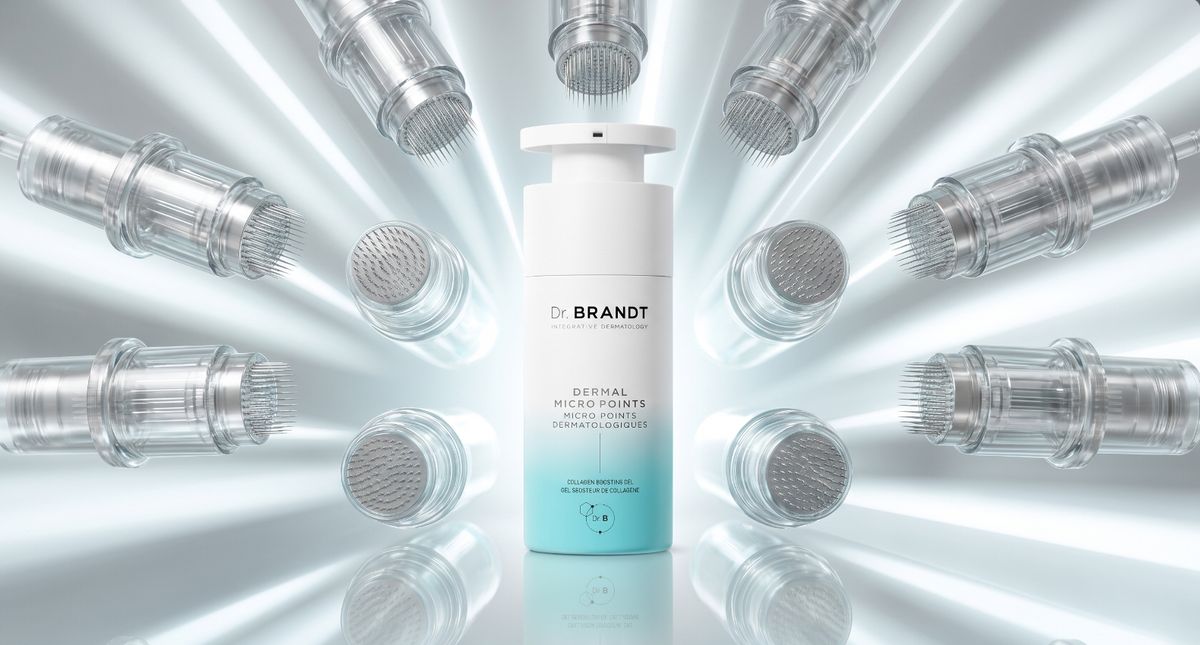
Microneedling spicules are microscopic, needle-shaped structures, most often naturally-derived. When you massage them into skin, they create tiny temporary microchannels in the outer layer. This is why spicule products, such as the Dr. BRANDT Dermal Micro Points Collagen Boosting Gel, are called "bio-microneedling" or "liquid microneedling." They exfoliate and help actives absorb, with no metal needles involved.
Definition: microneedling spicules
Microneedling spicules are natural silica micro-needles. In skincare, they are suspended in a gel, serum or powder. Applied with light pressure, they puncture the stratum corneum to boost exfoliation and product absorption.
Below, we explain what microneedling spicules are made of, how they work, and how they compare to in-office microneedling, peels and lasers. We also cover who should avoid them and how to use them safely at home.
Key takeaways
- Origin: microneedling spicules come from natural sources and are mostly made of silica.
- Mechanism: they work physically, not chemically. Massage pushes them into the stratum corneum, creating microchannels.
- Main benefit: better transepidermal delivery of the actives you apply with or after them, plus a smoother texture.
- Not the same as clinical microneedling: professional collagen induction therapy uses sterile metal needles at controlled depths and is regulated as a medical device.
- Normal sensation: tingling, warmth and short-lived redness are expected. Sensitive or broken skin should skip them.
- Example: Dr. BRANDT Dermal Micro Points Collagen Boosting Gel uses natural spicules as its core Microchannel Technology.

Liquid microneedling, in a bottle
For FirmnessFor Wrinkles Dr. BRANDT Dermal Micro Points Collagen Boosting GelA collagen-boosting gel powered by Microchannel Technology: naturally derived spicules instead of metal needles, with no office visit.
Shop nowAdd to cartIn this article:
- What microneedling spicules are made of
- How they work, step by step
- Spicules vs. traditional microneedling
- Key benefits for your skin
- Types of spicule products
- Spicules vs. chemical peels and laser
- Risks, side effects and who should avoid them
- How to use them safely at home
- Post-treatment care
- How to choose the right product
- Frequently asked questions
What Are Microneedling Spicules Made Of?
A spicule is a tiny element produced to support structural integrity. Most are made of silica, the same mineral found in sand and glass. Under a microscope, they look like sharp, rod-shaped needles with pointed ends.
The following name appears most often on ingredient lists and in research:
-
Hydrolyzed natural extractProcessed natural material often listed for spicule products on ingredient lists.

How Do Microneedling Spicules Work? The Science behind Topical Microneedling
Topical microneedling is a skincare approach that uses natural micro-needles, like spicules, instead of metal ones. Here is the mechanism of action, step by step.
-
Spicules enter the stratum corneum
The stratum corneum is the outermost layer of the epidermis, made of flattened dead cells. It is your skin's main barrier. When you massage a spicule gel in, the sharp tips lodge into this layer.
-
Microchannels open
Each spicule creates a tiny puncture. Thousands of them together form a dense network of microchannels you cannot see.
-
Actives travel deeper
Transepidermal delivery is the movement of ingredients through the epidermis. Microchannels make this easier. In a 2017 lab study, Haliclona spicules raised skin penetration of a test molecule about 33-fold versus untreated skin. A 2021 study saw a similar boost for peptides.
-
Skin responds and renews
A keratinocyte is the main cell type of the epidermis. Micro-injury nudges keratinocytes to renew faster. A fibroblast is a dermal cell that makes collagen and elastin. The hope is that this surface signal supports fibroblast activity over time, though cosmetic evidence here is still limited.
-
The barrier recovers
In lab testing, skin disruption from spicules was self-limited and recovered over time.

Microneedling Spicules vs. Traditional Microneedling: Key Differences
Collagen induction therapy (CIT) is a professional procedure that uses sterile needles to create controlled micro-injuries and trigger collagen production. It is also called percutaneous collagen induction or traditional microneedling. Microneedling spicules borrow the same idea but work far more superficially.
| Microneedling spicules (at-home) | Traditional microneedling (CIT) | |
|---|---|---|
| Material | Natural spicules | Stainless steel or titanium needles |
| Invasiveness | Superficial, mainly the stratum corneum | Deeper, device-controlled depth (often up to 2 mm or more) |
| Downtime | Hours (short-lived redness) | Usually a few days of redness |
| Pain level | Mild tingling or prickling | Moderate discomfort, often numbed first |
| Infection risk | Lower, no open needle wounds | Higher if tools are not sterile |
| Setting | At home, self-applied | In-office, by a trained practitioner |
| US regulatory status | Sold as cosmetics | Class II medical devices (FDA, 2018) |
| Best for | Texture, glow, product absorption | Deeper acne scars and wrinkles |
The cellular response also differs. Metal needles are non-biodegradable tools that are removed right away. They reach living skin and set off a stronger wound-healing cascade. Biodegradable silica spicules stay near the surface, so the response is milder.
What is the FDA status of spicules vs. microneedling devices?
In 2018, the FDA classified microneedling devices for aesthetic use as Class II medical devices. Its 2020 guidance says products that do not penetrate living skin, and are meant for exfoliation or skin appearance, are generally not medical devices. This is why at-home spicule products are sold as cosmetics.
Key fact: Professional microneedling devices are FDA Class II medical devices. At-home spicule products, which are meant for exfoliation and skin appearance, are sold as cosmetics.
Key Benefits of Microneedling Spicules for Your Skin
Here is what microneedling spicules can do, with a concrete use case for each.
-
Enhanced product absorptionMicrochannels help serums, peptides and hydrators reach deeper.Use case: applying a peptide serum right after a spicule gel.
-
Improved skin textureThe physical action smooths rough patches.Use case: dull, uneven skin after winter.
-
Reduced appearance of poresFaster surface renewal can make pores look tighter.Use case: an oily T-zone.
-
Help with congestionSpicules exfoliate and may help clear clogged pores.Use case: recurring blackheads on the nose and chin.
-
Brighter, more even toneFaster keratinocyte turnover sheds dull, pigmented cells.Use case: fading dark spots alongside a vitamin C serum.
-
Firmer-looking skinPaired with collagen-supporting actives, skin can look plumper.Use case: early fine lines around the eyes and mouth.
For the Dermal Micro Points gel, Dr. Brandt's studies show that using gentle circular motions during application can increase the penetration of active ingredients into the target area by as much as 3000%. In addition, lab testing showed up to a 63% increase in collagen levels after just 48 hours.
UP TO3000%
increase in the penetration of actives into the target area, with gentle circular motions
UP TO63%
increase in collagen levels after 48 hours
Brand data for Dr. BRANDT Dermal Micro Points. Collagen result: in vitro evaluation via confocal microscopy in human fibroblasts.
Can Microneedling Spicules Help with Acne and Hyperpigmentation?
Acne is the best-studied use. The research is on spicules powder as a drug candidate, not on cosmetic gels. In a 12-week Phase 2b trial, 181 patients with moderate to severe acne used a weekly spicule treatment called DMT310. The later Phase 3 STAR-1 trial enrolled 520 patients and met all three primary endpoints.
Researchers think spicules help by exfoliating and opening clogged pores. Lab work also suggests that their compounds act on acne bacteria and inflammation.
For post-inflammatory hyperpigmentation, evidence is thinner. Faster cell turnover can help dark marks fade. Results depend mostly on the brightening actives you pair with spicules.
Types of Microneedling Spicule Products
Spicules now appear in several formats. Here are the main types and when each makes sense.
-
Spicule gelsA gel base you massage in, then follow with serums. Example: Dr. BRANDT Dermal Micro Points Collagen Boosting Gel.
-
Spicule serumsSpicules plus actives in one step, like peptides or hyaluronic acid.
-
Spicule powdersDry powder mixed with a liquid before use. These are often stronger.
-
Spicule masks and peelsA leave-on or rinse-off treatment, used less often.
-
Professional spicule treatmentsHigher-strength protocols done by estheticians, sometimes called "herbal peels."
Microneedling Spicules vs. Chemical Peels and Laser
Spicules are not the only way to resurface skin. This chart compares typical downtime across popular treatments.
| How it works | Typical downtime | |
|---|---|---|
| At-home microneedling spicules | Physical microchannels in the stratum corneum | A few hours to 1 day |
| Professional microneedling (CIT) | Sterile needles at controlled depth | 1 to 3 days |
| Light chemical peel | Acids dissolve surface cells | 1 to 7 days |
| Medium chemical peel | Deeper acid exfoliation | 7 to 14 days |
| Non-ablative laser | Heat below the surface, no wound | A few days |
| Ablative laser | Removes outer skin layers | 1 to 3 weeks or more |
Peels and lasers reach deeper concerns but need more recovery. Microneedling spicules suit people who want gentle, regular resurfacing with almost no downtime.
Risks and Side Effects: Who Should Avoid Microneedling Spicules?
Spicules work by disrupting the skin barrier on purpose. That means more caution than with a regular serum.
Common, expected side effects
- Tingling, prickling or a "sandpaper" sensation
- Warmth or flushing
- Mild redness for a few hours
- Itching during or after application
- Temporary dryness or flaking
Skip spicules, or ask a dermatologist first, if you have
- Sensitive, compromised or broken skin
- Active rosacea, eczema or psoriasis flares
- Open wounds, cold sores or active skin infections
- Recent in-office procedures such as peels, lasers or microneedling
- A plan to use strong retinoids or acids the same night
Lab research found some spicules can stay in skin for up to 72 hours. This is another reason to avoid stacking harsh actives right after use.
How to Safely Use At-Home Microneedling Spicule Products
Follow these steps for a safe at-home application. Always check your product's own directions first.
-
Patch test 24 hours before
Apply a small amount behind the ear or on the jawline. Wait a full day. Skip the product if you see swelling, hives or burning.
-
Cleanse and dry your skin
Spicules work best on clean, fully dry skin.
-
Apply a small amount
Use the dose on the label. More product does not mean better results.
-
Press and massage gently for 30 to 60 seconds
Use light circular motions. Never scrub hard.
-
Leave on as directed
Some formulas stay on overnight. Others are followed by serums.
-
Follow with soothing care
Layer calming, hydrating products (see post-treatment care).
Using Dr. Brandt Dermal Micro Points Collagen Boosting Gel
The Dr. BRANDT Dermal Micro Points Collagen Boosting Gel is part of the "Needles No More" collection. It uses natural silica spicules as its Microchannel Technology. Per the brand's product documentation:
10 × 250-300
Spicule size: about 10 microns wide and 250-300 microns long
3M
Microchannels: designed to create about 3 million microchannels in the epidermis within 5 minutes
20-30 min
Dissolution: spicules dissolve within 20-30 minutes of application
24 h
Full breakdown: fully degraded into water-soluble components within 24 hours, without reaching the dermis or bloodstream
How to use it:
-
Apply at nightApply to clean, dry skin with gentle circular motions.
-
Expect a tingleExpect tingling, redness, itching or warmth.
-
Powered by activesLayer with the brand's Skin-Lifting Complex actives, including peptides and GABA.
-
Alternate with exfoliationDo not use it the same night as microdermabrasion. Alternate nights instead.
It is inspired by professional microneedling, not a replacement for it. Patch test first if your skin is reactive.


Individual results may vary.
Needles No More collection
For FirmnessFor Wrinkles Dr. BRANDT Dermal Micro Points Collagen Boosting GelMassage into clean, dry skin at night. Inspired by the visible benefits of professional microneedling, without the needles.
Shop nowAdd to cartPost-Treatment Care After a Spicule Application
Your skin is more permeable after spicules. What you apply next matters.
-
HydrateUse hyaluronic acid, ceramides or a peptide serum.
-
SootheLook for panthenol, centella or allantoin.
-
Skip harsh actives for 24 hoursNo strong retinoids, AHAs, BHAs or scrubs.
-
Wear SPF 30 or higher the next dayA disrupted barrier can be more sun-sensitive. Shop broad-spectrum SPF.
-
Avoid heat and sweat that nightSkip saunas, hot yoga and very hot showers.
-
Keep hands offDo not pick or rub tingling areas.


Step 2 · Hydrate
For WrinklesFor Dryness Dr. BRANDT Hyaluronic Face Cream 2.0Hyaluronic acid to plump and hydrate freshly treated skin.
Shop nowAdd to cart
Step 3 · Soothe overnight
For Damaged BarrierFor Dryness Dr. BRANDT Hydro Biotic Recovery MaskA recovery mask to calm and support the skin barrier overnight.
Shop nowAdd to cartHow to Choose the Right Spicule Product for Your Skin Concerns in 2026
Not all microneedling spicule products are built the same. Use this checklist.
-
Match the active to your goalPeptides for firmness, niacinamide for pores, vitamin C for dark spots.
-
Check the ingredient listLook for "spicules".
-
Look for spicule size or density dataBrands that share specs are easier to trust.
-
Start with a gel or serumThese are usually gentler than powders for beginners.
-
Avoid heavy fragranceIt adds irritation risk on freshly opened skin.
-
Check usage frequencyGentler formulas allow more regular use.
The Bottom Line on Microneedling Spicules
Microneedling spicules are a less invasive alternative to traditional microneedling. They use natural silica needles to open microchannels in the stratum corneum. The main payoffs are smoother texture, more glow and better absorption of your actives. Acne research is promising, though it focuses on drug-grade natural spicules, not cosmetic gels. Safe use comes down to patch testing, gentle application and calm aftercare. As research grows, bio-microneedling is likely to remain a key at-home skincare category in 2026 and beyond.
FAQ About Microneedling Spicules
What is the difference between spicules and microneedling?
Spicules are natural, biodegradable micro-needles massaged in from a gel or serum. Traditional microneedling uses a device with fixed metal needles. It reaches deeper skin layers and is done in-office.
Are microneedling spicules painful?
No, most people feel tingling or slight prickling, not pain. This sensation is normal and usually fades within minutes to a few hours.
Are at-home microneedling spicule treatments safe to use?
They are generally safe for most skin types when used as directed. Always patch test first. Avoid them if you have sensitive or broken skin, active infections or a skin condition flare.
How often should you use microneedling spicules?
It depends on the product's strength. Many at-home formulas are used a few times a week at most, while stronger treatments are spaced 1 to 2 weeks apart. Follow the label.
Can you see the spicules in your skin after application?
No. Spicules are microscopic, so you cannot see them. You may feel a light prickle when touching your skin.
What are the main side effects of using spicules?
The most common are tingling, warmth, redness, itching and mild dryness. These usually settle within a day. Stop use if you notice swelling, hives or lasting burning.
How long do the effects of a spicule treatment last?
The microchannels close within hours to a few days as the barrier recovers. Texture and tone results build with regular use over several weeks.
Can spicules help with acne scars and wrinkles?
They may soften the look of mild texture and fine lines over time. Deep acne scars and wrinkles usually respond better to professional microneedling or laser.
What should I look for on the ingredient list of a spicule serum?
Look for the spicules mention plus supporting actives like peptides or hyaluronic acid. Avoid formulas heavy in fragrance or high-strength acids.
Curious how this technology works in an actual formula? Explore the Dr. BRANDT Dermal Micro Points Collagen Boosting Gel to see how spicules pair with the brand's Skin-Lifting Complex.
Ready to try liquid microneedling?
For FirmnessFor Wrinkles Dr. BRANDT Dermal Micro Points Collagen Boosting GelSmoother, firmer-looking skin with an at-home step you can add to your nighttime routine. Patch test first if your skin is reactive.
Shop nowAdd to cartSources
- Skin Delivery of Hydrophilic Biomacromolecules Using Marine Sponge Spicules (2017), Molecular Pharmaceutics
- Spicule-based topical delivery of therapeutic peptides (2021), Pharmaceutics
- Classification of the Microneedling Device for Aesthetic Use, final order (2018), FDA, Federal Register
- FDA finalizes guidance on microneedling devices (2020), RAPS
- Once-weekly topical therapy shows promise for moderate to severe acne (2023), MDedge, reporting on JAAD
- Topline results: freshwater sponge-based acne treatment hits all primary endpoints in Phase 3 trial, Dermatology Digest


Leave a comment
This site is protected by hCaptcha and the hCaptcha Privacy Policy and Terms of Service apply.