
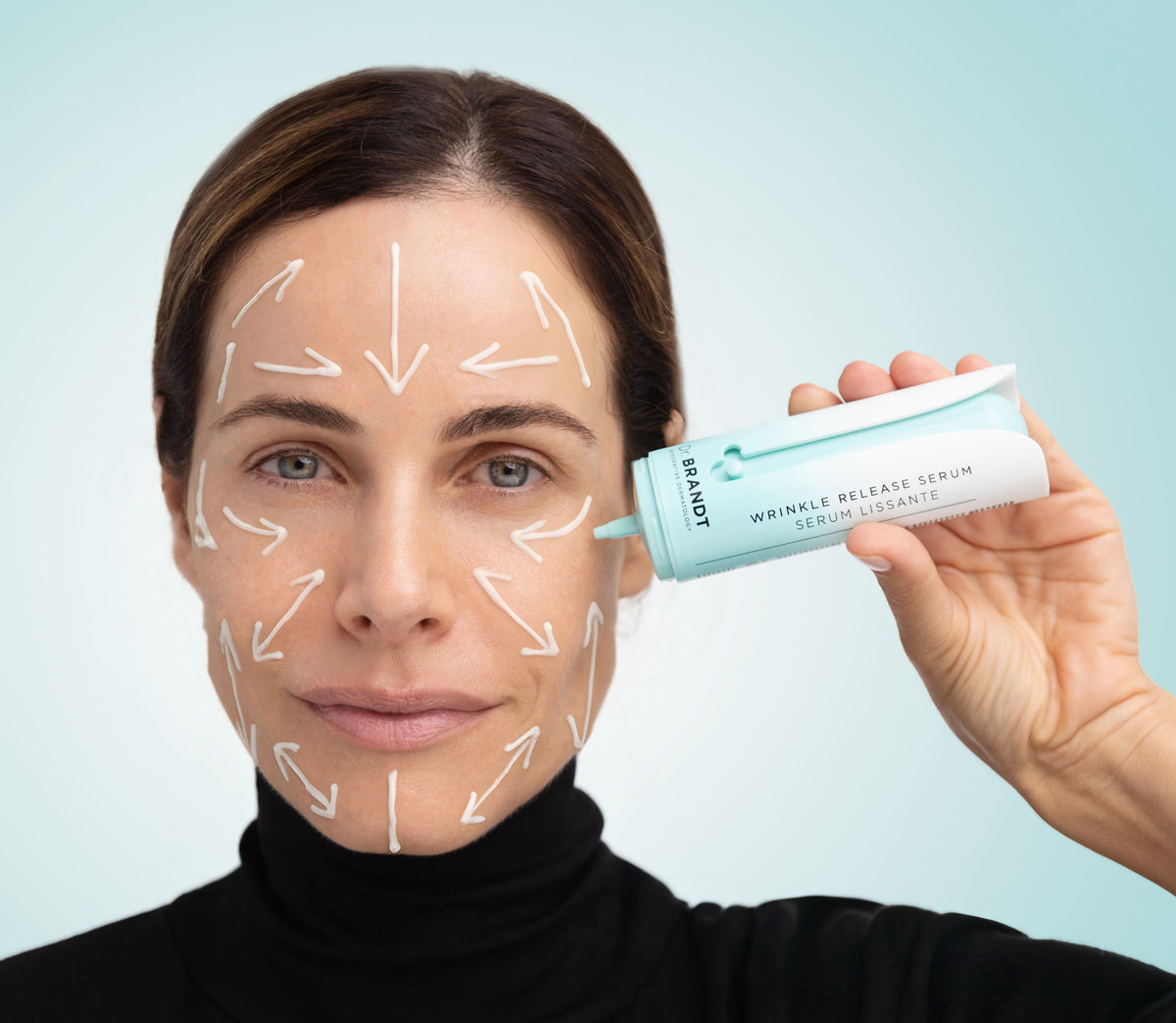
Botox-Like Skin Care: Key Ingredients & Benefits
"Botox-like" skin care refers to topical products, usually serums or creams built around peptides and other actives, that are formulated to visibly soften the look of expression lines, the creases that form from repeated facial movement like frowning or squinting. These products don't work the way injectable Botox does: Botox is a prescription neuromodulator that temporarily blocks nerve signals to targeted muscles, while topical skincare works at the surface and upper layers of skin. Understanding that distinction is the key to knowing what a "Botox-like" product, such as the Dr. BRANDT Wrinkle Release Serum, can realistically do for the skin on your face, and where it fits alongside (not instead of) professional treatment.
Key takeaways
- Injectable Botox is a prescription neuromodulator that temporarily blocks nerve signals to targeted facial muscles, reducing the movement that causes expression lines.
- "Botox-like" skincare products don't block nerve-muscle signaling; they're topical formulas built around peptides and other actives designed to visibly soften the look of expression lines and support skin firmness over time.
- Common ingredient categories in this space include hexapeptides, GABA-inspired actives, and skin-conditioning ingredients like adenosine and hyaluronic acid, each with a different proposed mechanism than an injectable.
- Topical "Botox-like" products typically require weeks of consistent use to show visible signs of change, compared with injectables, which are administered in a single session with results building over the following days.
- Dr. Brandt's Wrinkle Release Serum is one example of a topical product in this category, built around Vegan PDRN, Adenosine, and a four-ingredient tightening complex: positioned as a topical alternative inspired by injectable-style results, not a replacement for them.

The needle-free alternative
For FirmnessFor Wrinkles Dr. BRANDT Wrinkle Release SerumThe third generation of Dr. Brandt's iconic "Botox in a Bottle": a full-face serum with Vegan PDRN, Adenosine and a 4-ingredient tightening complex, for an immediate soft-focus effect and smoother-looking skin over time.
Shop nowAdd to cartIn this article:
- What Botox actually does to skin and muscles
- What "Botox-like" skincare actually means
- Ingredients that show up in Botox-like skincare
- What to look for in a Botox-like serum or cream
- Results timeline: Botox-like skincare vs. injectables
- Can skincare replace Botox?
- Where Dr. Brandt Wrinkle Release Serum fits in
- Frequently asked questions
What Does Botox Actually Do to Skin and Muscles?
Botox is the brand name most commonly associated with botulinum toxin type A, a prescription injectable that belongs to a category of drugs called neuromodulators. Administered by a licensed medical professional, it works by temporarily blocking the nerve signals that tell specific facial muscles to contract:
Blocks the signal
The injection temporarily blocks the nerve signals that tell specific facial muscles to contract.
Relaxes the muscle
Because the muscle can no longer contract as forcefully, the skin above it creases less.
Softens the lines
Expression lines like forehead lines, frown lines, and crow's feet look softer.
Results from injectable neuromodulators typically become visible within several days and are commonly described as lasting a few months before the effect gradually wears off and the treatment needs to be repeated. This is a medical procedure with a defined mechanism of action, administered under professional supervision: a meaningfully different process than applying a topical product at home.
Key fact: Botox is a prescription injectable administered by a licensed medical professional. Its effect typically shows within days and lasts a few months before a repeat treatment is needed.
What Does "Botox-Like" Skincare Actually Mean?
"Botox-like" is a marketing shorthand, not a scientific claim of equivalence. When a skincare product is described this way, it generally means the formula is designed to visibly soften the look of expression lines or improve skin firmness: the same visual goals as an injectable, but through a completely different mechanism.
Topical skincare doesn't reach the neuromuscular junction the way an injectable does. Instead, these products work at the skin's surface and upper layers, using ingredients intended to smooth texture, support the skin's structural proteins, or create a temporary tightening or "soft-focus" effect on how lines look. A product can be genuinely effective at those goals without working the same way as, or producing the same outcome as, an injectable neuromodulator. That distinction matters both for setting realistic expectations and for understanding what you're actually buying.
Definition: Neuromodulator
The clinical term for a drug that changes how nerve signals are transmitted. It's the category Botox belongs to, and it's specific to injectable treatments, not skincare ingredients.
What Ingredients Show Up in Botox-Like Topical Skincare?
The "Botox-like" category isn't built on one single ingredient: it's a loose grouping of peptides and other actives that skincare brands formulate with the goal of visibly relaxing or smoothing the look of expression lines. Common examples across the category include:
A few things are worth knowing about how these ingredients are typically tested and marketed. Efficacy data you see cited for a peptide or complex often comes from testing the raw ingredient in isolation, not the finished, formulated product it ends up in. That's a meaningful distinction: an ingredient that performed well on its own in a lab test doesn't automatically mean the finished serum containing it has been tested and shown to deliver the same result. Reputable brands will tell you which is which.
Key fact: Ingredient-level data (a raw ingredient tested in isolation) and finished-product data (the formula you actually buy, tested as a whole) are not the same thing. Look for the latter.
What Should You Look for in a Botox-Like Serum or Cream?
Not every "Botox-like" product on the market is built the same way, and figuring out which cream or serum is actually worth your money starts with the ingredient list rather than the marketing claim on the bottle. A few ingredient categories tend to show up again and again across this space, each aimed at a slightly different part of the skin's appearance:
-
Hyaluronic acidWidely used to help hydrate and temporarily plump the skin, which can make fine lines look less pronounced without changing muscle movement.
-
Collagen-supporting peptidesIncluded to help boost collagen production or otherwise support the skin's structural proteins, since collagen naturally declines with aging.
-
Texture and skin barrier supportFormulated to help the skin feel smoother and more resilient, which can factor into how deep wrinkles, lines and crepey-looking skin appear day to day.
-
Antioxidants, including vitamin E or CAdded to help protect against environmental stressors that can otherwise accelerate visible signs of aging.
-
Eye creams and targeted treatmentsA related but distinct category, usually formulated more gently for the thinner skin around the eyes rather than the full face.
Dermatologists and estheticians generally agree there's no single ingredient that works as a stand-in "wrinkle reduction" switch the way a neuromodulator does: products that provide real benefit tend to do so gradually, through consistent use, not as a one-time fix. If a serum or cream claims to reduce the appearance of deep wrinkles overnight, that's generally a sign to read the fine print rather than take the claim at face value.
Choosing between formulas also comes down to your own skin and what you're trying to address. Someone focused on early, fine expression lines may prioritize a lightweight serum aimed at reducing fine lines through daily use, while someone looking at more established lines and wrinkles might lean toward a richer cream layered with a tightening complex. A well-formulated product can meaningfully improve overall skin texture and support overall skin health over time, but it can't fully replicate what a prescription neuromodulator does at the muscle level. In either case, pairing a topical step with sun protection and a consistent routine generally goes a long way toward supporting results, whatever formula you choose.
How Long Does It Take to See Results, Botox-Like Skincare vs. Injectables?
Timelines are one of the biggest practical differences between Botox-like topical skincare and injectable neuromodulators like Botox, and it's worth setting expectations accordingly.
| Injectable neuromodulators | Botox-like topical skincare | |
|---|---|---|
| Administered by | Licensed medical professional | You, at home |
| Typical onset | Days after treatment | Gradual, often described as building over weeks with consistent use |
| Typical duration of effect | Several months before a repeat treatment is needed | Ongoing: effects are generally tied to continued, regular use |
| Mechanism | Blocks nerve signals to targeted muscles | Works at the skin's surface and upper layers via peptides and conditioning ingredients |
The practical takeaway: don't expect a topical "Botox-like" serum to change your skin overnight, or to hold its visible effect the way an injectable does once you stop using it. Most people who see results from this ingredient category describe gradual improvement in the look of expression lines and firmness over weeks of consistent AM/PM use, not an immediate transformation after a single application, with the exception of temporary, surface-level effects some formulas describe immediately after applying, like a soft-focus look.
Can Skincare Replace Botox, or Is It More of a Complement?
Topical skincare and injectable neuromodulators aren't interchangeable: they work through different mechanisms, are administered differently, and are held to different standards of testing and regulation.
In practice, most people use these products as complements rather than substitutes: a topical "Botox-like" serum as a daily step for the general look of expression lines and skin firmness, either as a standalone routine for those who aren't interested in injectables, or alongside professional treatment for those who are. Dr. Brandt has described the philosophy behind its own long-running "Botox in a Bottle" product line this way:

It wasn't about replacing procedures, it was about extending them.
That framing is a useful way to think about the category as a whole, not just one brand's product.

Where Does Dr. Brandt Wrinkle Release Serum Fit Into the Botox-Like Skincare Category?
The Dr. BRANDT Wrinkle Release Serum is one example of a product in this space, the third generation of a line that traces back to 2002, when founder Dr. Fredric Brandt created "Crease Release," a GABA-based formula built to instantly soften the look of crow's feet and expression lines. That original formula is where the brand's long-running "Botox in a Bottle" nickname started, and it's carried through two more generations since:
2002 · Generation 1
Crease Release
A GABA-based formula built to instantly soften the look of crow's feet and expression lines, and the origin of the "Botox in a Bottle" nickname.
Generation 2
The line evolves
The "Botox in a Bottle" formula carries forward into a second generation.
March 2026 · Generation 3
Wrinkle Release Serum
The current full-face serum, launched alongside Dr. Brandt Skincare's 30th anniversary.
The current formula centers on Vegan PDRN (a barley-sprout-derived alternative to traditional PDRN), Adenosine, and an Advanced 4-Ingredient Tightening Complex, plus Vitamin E:


Dr. Brandt describes it as designed to visibly soften the appearance of expression lines with an immediate soft-focus effect upon application, with skin feeling stronger, more resilient, and more youthful-looking over continued use. It's formulated for the full face (the first generation in this line to move beyond upper-face-only targeting) and is suitable for all skin types and tones, with no sensitive-skin exclusion stated by the brand.

Clinical results for the finished serum demonstrate noticeable improvements across multiple areas:
UP TO42%
Immediate improvement in crow's feet
Instrumental evaluation
Instrumental evaluations
UP TO28.6%
improvement in full-face wrinkles in 2 weeks
UP TO24.8%
improvement in firmness
UP TO72.5%
improvement in facial sagging volume
Consumer self-assessment after 14 days
90%
reported improved skin texture
83%
noted improved crepiness
90%
felt skin looked more lifted or refreshed


Individual results may vary.
As with the rest of the category, it's positioned as a topical alternative inspired by injectable-style results.
To use it, apply AM and PM on clean skin, focusing on expression lines and creases, then follow with a moisturizer such as the Hyaluronic Face Cream to lock in hydration.
Step 1 · Smooth
For FirmnessFor Wrinkles Dr. BRANDT Wrinkle Release SerumApply AM and PM on clean skin, focusing on expression lines and creases.
Shop nowAdd to cart
Step 2 · Hydrate
For WrinklesFor Dryness Dr. BRANDT Hyaluronic Face Cream 2.0Follow with a hyaluronic acid moisturizer to plump and hydrate.
Shop nowAdd to cart
Get both, limited time
For FirmnessFor Wrinkles Dr. BRANDT Wrinkle Free Holiday DuoThe Wrinkle Release Serum paired with the Hyaluronic Face Cream for instantly smoother-looking skin and lasting results, with a complimentary pouch.
Shop nowAdd to cartFAQ
Does "Botox-like" skincare actually work like Botox?
No. Botox is a prescription neuromodulator that blocks nerve signals to targeted muscles; "Botox-like" skincare is a topical product that works at the skin's surface and upper layers through peptides and other actives. The two can share a visual goal, softer-looking expression lines, without sharing a mechanism.
How long before I see results from a Botox-like serum?
Most brands describe gradual improvement over weeks of consistent use, sometimes alongside a temporary, immediate surface effect right after application. This is different from injectables, where visible change is typically reported within days of treatment.
Can I use a Botox-like serum if I already get Botox injections?
Many people do use topical products alongside professional treatment, since they work through different mechanisms and address different parts of the skin. If you have questions about combining the two, it's worth checking with the professional administering your injections.
Are peptides in skincare actually proven to reduce wrinkles?
Individual peptides and complexes often have ingredient-level testing data showing effects when evaluated in isolation. Whether a specific finished product delivers the same result depends on that product's own clinical testing, so it's always worth checking whether a brand is citing ingredient-level or finished-product data.
Is Dr. Brandt Wrinkle Release Serum the same as getting Botox?
No, the Wrinkle Release Serum is a topical serum positioned as an at-home alternative inspired by injectable-style results, not a substitute for the procedure itself. The brand is explicit that its goal is extending routines, not replacing professional treatment.
The Bottom Line
If you're curious about the "Botox-like" skincare category, the most useful mindset is realistic expectations: these products are formulated to visibly support smoother-looking expression lines and firmer-feeling skin through consistent use, not to replicate what an injectable neuromodulator does. The Dr. BRANDT Wrinkle Release Serum is one option built around Vegan PDRN, Adenosine, and a four-ingredient tightening complex, packaged as a full-face, AM/PM step for anyone wanting a topical addition to their routine, whether that's a starting point before considering in-office treatment, or a daily complement alongside it.
Ready to try Botox in a bottle?
For FirmnessFor Wrinkles Dr. BRANDT Wrinkle Release SerumA full-face, AM/PM serum for smoother-looking expression lines and firmer-feeling skin, with an immediate soft-focus effect. Suitable for all skin types and tones.
Shop nowAdd to cart


Leave a comment
This site is protected by hCaptcha and the hCaptcha Privacy Policy and Terms of Service apply.